EPQ
Primary research- Survey and interview
Why I want to do a survey?
I want to do a quick survey which will help me understand what my audience expects and also more information about them that I could take into consideration and include in my documentary. Through this survey I will also make sure that the questions are relevant to my research and what I want to be finding out. I will send it to about 5 young people. I have chosen to send it to people around my age because those are one of my main target audiences, and their opinions and what they think matter the most in terms of what I should be including in my documentary. I will also have a better idea on what their opinions and preferences are in terms of mindfulness. I have decided I will be asking 5 questions that are going to be shown below. Also when I look at the responses I can figure out which was a popular opinion people had and what it could like link to.
Questions I have chosen for survey:

So these are the five questions that I chose in terms for the google survey that I will be doing and sending out to around five people. The first question that I chose was to know about a quality they would like to embody in terms of their mental wellbeing, I have chosen this question because it will help me know how I could add advice that links to those qualities so for instance is someone said being more self motivated I could include ways in which I motivate myself and also ask the expertise what a resolution could be for becoming more motivated. The next question I chose was to know if they're having any issues whatsoever who would they turn to if they needed any advice or help. This will then link to clips I will include of my friends because they are someone I would turn to when I have issues, and if anyone else is the same this could resonate to them. The third question states about the kind of coping methods that young people would use, from this I will understand a bit more about what works for them and once again how I can include something relating to those methods in my documentary and also expand on them. Furthermore, the fourth question is the main question about my topic itself which is mindfulness. I want to know a bit better about what they think it is and their opinion on it. It will help me get a broader understanding about what they know about mindfulness, and if they're not getting much of an understanding this will then be useful in expanding about what mindfulness really is and making it simpler for my audience to understand. Then finally, for my last question I decided to ask if they find that mental health advice coming from professionals is actually useful to them. I have decided that I will use a mental wellbeing counselor and someone that deals with similar issues in the NHS in my documentary, so that the audience can also have tips from expertise rather than just my opinions, as some of the things expertise might say might actually link to what what I may be advising. This is why I chose all these questions, overall I just want a better idea of what they're opinions are like about my subject and how they portray mindfulness and wellbeing in general.
Responses
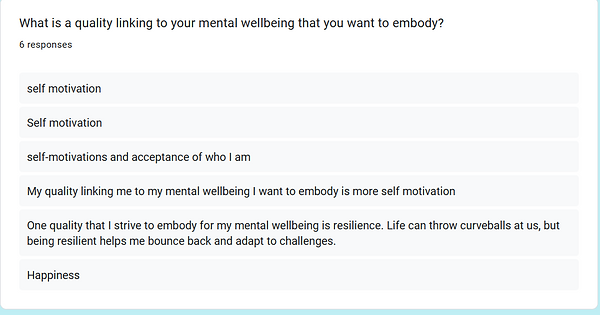
So this first question that I chose I wanted it to inform me about what my audience aims for in terms of mental wellbeing. So from the answers I got the main quality that was listed was self motivation. I think in general a lot of young people struggle severely with trying to find motivation or just getting motivation back, and this is mainly to do with like schoolwork many tend to struggle with getting motivation to complete something to their best ability and it could be because of many factors such as giving up easily or just not making or having the time. And I am glad many people mentioned that because it is something I struggled with for years as well. And in my documentary I will then talk about what I did to overcome these challenges to do with motivation, but also ask the expertise what tips they have in terms of finding motivation. I also think that resilience which is one more that someone stated is quite similar to the topic of self motivation, because that is what is needed to work through difficult times like stress and if you find that strong motivation regardless of other circumstances if you're resilient you can just keep moving. So these two have a link and I will make sure to expand on resilience through my documentary because it is a key aspect. The other two were happiness and acceptance of who they are, I obviously do not think I could help someone be happy immediately but however in my documentary I could advise little steps that are needed in order for you to reach your goal of having happiness and self acceptance.

Now this is just a general question I asked linking to who do they turn to if they're facing any issues or having a difficult time. From this I can see that the most popular answer was friends and also no one, but friends being the biggest solution if they're having a hard time. I think that it is so helpful when spending time with your friends when you're having issues personally as well, and this is great because I wanted to film clips of friends myself that I will include in my documentary as I wanted to state how spending time well with good people has positively impacted my mental health. So it is a relieve knowing many people use that as their first option when they might be suffering mentally, and it seems like it is helpful since many people chose that option. However, the other response that a minority picked was turning to no one if they're facing problems, I think that is also a major issue that many teenagers face because they would rather bottle things up to themselves and deal with it alone or just try to be distracted. I do think that if you don't have good friends or anyone to rely on sometimes that might eb the only option. But personally I bottle my problems all the time and forget it over time, so I want to explain in my documentary how it is not okay to suffer alone in silence but if you really can't rely on anyone you have to make sure you're dealing with those problems properly, and how to deal with such issues alone I will make sure to include tips about that too in my documentary.
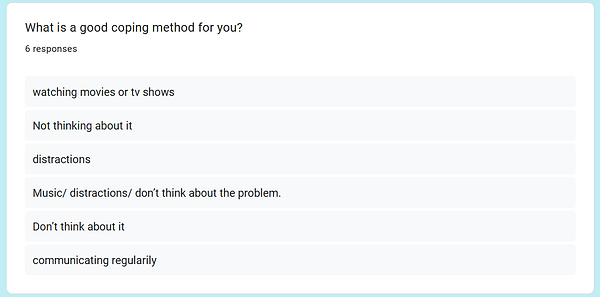
So I asked this question to know a bit about the kind of methods young people would use. A common answer was to just not think about the problem. I think that this depends on what issue it is if it is something serious and needs to be dealt with you can't just ignore such problems because eventually they'll come back and you will be thinking about it again. So I do not think it is a healthy way of coping, so rather then not thinking about it in my documentary I will definitely not mention just ignoring the problem but instead I will find and state healthy coping mechanisms that could help even in resolving the issue. Another few related common methods were distracting themselves either through music or watching movies. I do think these are good coping methods because they can be so useful as you can go into your own world especially when watching movies because your mind if focused on that one thing. I think these are really good methods as for short term distractions, and I will incorporate and could include these in my documentary. And the final one which is communicating regularly is actually a healthy coping method that can be useful for long term to be honest. This is one that I want to expand on my in documentary because it is something I have struggled with and still do, but i have worked on some parts of it so I want to include that because communicating can be very difficult. But I want to include simple ways to actually work towards communication.

This is an important question I felt that I needed to ask so I know whether if the audience knows anything about mindfulness and if not how would I be able to use my documentary on expanding their knowledge. From the responses that I got I think that many people do not understand what mindfulness really is, it can be defined in many different ways and other people may portray it differently. But the main idea of mindfulness is just to be aware of your surroundings and pay attention to thoughts without judging them or overreacting every time. Like one of the responses said it is just being in the present and not worrying about the future or the past as it is something you cannot control. From this it seems like many young people try to know ways on how they can practice it such as through meditation or watching things, or even listening to music. But in my documentary I want to mention about how it is a lot more simpler then we make it and how you can be more mindful every day effortlessly.
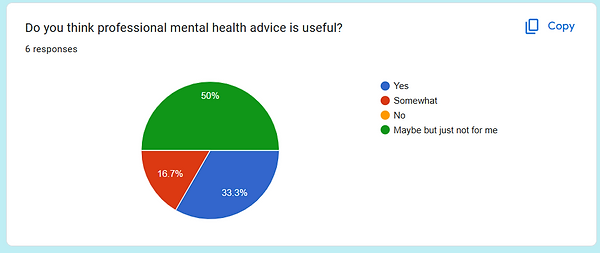
For the final question I decided to ask this if people think that seeking advice from professionals is useful. The most common response was maybe but just not for them. I think that if I was doing this survey I would've done the same, I think its either because people have tried to seek help from professionals an did not gain the support they needed or simply they just haven't tried at all. If it is the case of just not trying it yourself and assuming it won't be helpful, they could be either right or wrong. In my documentary I will include interviews from expertise such as wellbeing counsellors and show discussions with them, and maybe the viewers might have a changed perspective of them and could try seek professional help. The next popular response was yes that is it useful, I am glad many people also think that because once again it will be in my documentary and i will make sure to talk about the benefits of seeking advice from someone professional. I am also glad nobody said no so this means people can resolute to mental health advice from professionals an actually consider it, which is what I want because my aim is to help out people.
How is this survey going to be useful for my documentary?
First of all, I do think all these questions are beneficial in informing me more about my target audience and I was able to make a lot of conclusions through their responses. From this survey I was able to figure out the aims that my audience would want to reach at in terms of their wellbeing, and this is useful for me because I can include small steps that could help them reach their goals and include what they can do daily to better themselves. And since my main subject is about mindfulness through one of the questions I asked about mindfulness I was able to know what they think of it and how they view it, and this is necessary for me to know because if there is any lack of understanding I could simple it down in my documentary and make it basic for people to understand and practice mindfulness. I also knew more and understood about the solutions my target audience would resolute to when they're having a hard time, I can then pick up on what is not being said and add it to my documentary, or I could expand on some of the ideas that people find helpful. So possibly other viewers might find that helpful too especially if it is a common solution, but I will make sure to expand on it. Moreover, this survey as a whole was informative in terms of finding what my target audience thinks and how they cope with issues. So now I do have a better understanding to what I should be including in my documentary that my viewers would actually find useful as that is my aim of this project.
Interview
Why am I doing this interview?
So this interview is going to be mainly based about documentaries as a whole. So for the survey I asked about mental health and mindfulness but for the interview I want this to be more documentary based so asking a few people what they think about documentaries involving wellbeing and mental health and if they would actually watch them. And I will also make sure to ask if they would watch it what would they expect this documentary to involve, this will be helpful for me to know what else I could be including in my documentary. And once again I will ask people that are specific to my target audience because I need to know their opinions on such a documentary and whether they would prefer it. And I want to ask three questions only in this interview which are going to be stated below.

Interview questions:
Question 1, Do you think that documentaries related to mental health and wellbeing could be beneficial?
Question 2, If a documentary about mindfulness and advice on mental health issues is made, would you watch it and why?
Question 3, What is a main point that a documentary about mental wellbeing and mindfulness should have?
Response one:
Question 1, Yes because they can raise awareness about mental health problems and this can even help people to seek help sooner and try out things that can help them.
Question 2, I would possibly watch it because it may help me through advice it could include and also I can then share that knowledge with other people so I think I would watch a documentary about mindfulness and mental health problems.
Question 3, The main point the documentary should include about those is that how to practice mindfulness and also real coping mechanisms rather than something just like read a book.
Response two:
Question 1, They can be quite informing especially when it comes to listing different methods of finding help.
Question 2, I would watch it because it can help me in trying new things to help myself and practice mindfulness.
Question 3, Evidence from like professionals such as therapists that share experiences or tips.
Response three:
Question 1, For some people it could be.
Question 2, I could watch it because I do like to watch documentaries in general so one like that could be interesting.
Question 3, Promoting like positive mental health and how to just be more resilient.
Response four:
Question 1, Yes and no. Yes because they can be used as an informative tool to help raise awareness and no because people may not take it like seriously.
Question 2, I quite like watching documentaries so I would watch it and see what it's message is and stuff.
Question 3, For like mindfulness it should provide accessible tools that people can actually use in order to practice it.
Response five:
Question 1, I probably could if it is interesting and appealing to watch.
Question 2, Maybe if it actually talks about important things and how you could tackle issues to do with mental health.
Question 3, How like mindfulness can be applied in daily lives.
What I am able to gather from this interview?
This interview was quite useful, this is because I now have a better idea and concept of what I should include in my documentary on mindfulness in order for it to be actually appealing to my viewers. So the main question that helped me summarise those conclusions was the third question which asked which main point should a documentary relating to mental wellbeing and mindfulness should include. A common response I was able to gather was to actually show what mindfulness is and how easily it ca be accessed because if not people would obviously not know how to practice it, so when I am doing my documentary I will make sure to list simple ways in which we can be mindful everyday. As well as that someone also said to actually mention realistic and more useful advice in terms of listing things in order to help with mental health, which I also agree with to a high extent because most of the things out there are really not useful and not worth doing so I will make sure to actually incorporate useful mechanisms and advice that is actually worth trying out. Another important point I picked up was including profession advice, which is exactly what I will be doing to use as evidence in my documentary because some people may prefer to hear advice from professionals. And a final point I thought was useful was making it interesting and appealing, in order for that I will have to make my documentary unique so for that I will try to include things that aren't already out there so when I share personal experiences this will obviously be different to what is already out there so then viewers might find new approaches from this and try new things. And in order to make it appealing I will have to make sure that I am including relevant archive material and also the editing will have to be at a good standard in order for it to turn out to be appealing, so I will make sure to watch tutorials and incorporate that into my own editing. Moreover, to conclude I think that the information I was able to pick up on from this interview was useful in telling mw what I should be including in my documentary in order for my target audience to actually enjoy and learn something from it.
Research and analyse documentaries
A critical state of mind-Documentary
So to begin with, this documentary starts off talking about a disclaimer of how the documentary talks about suicide and mental health as well as that it also lists below two different numbers you could call if you have thoughts of like self harm or suicide. I prefer how it adds that in the beginning to disclaim any viewers of what they're about to watch in case someone can't watch things like that but I also really like how they made sure to add help by including phone numbers people could call if they need help. From this I would actually like to do something similar by adding like people you could call if you're struggling in the beginning of my documentary. That text with a black screen in the background is then kept for the 25 seconds. Then shows the name of the producer with presents and here music starts to incorporate, then it fades onto a clip of trees and the sun beaming through with music still going on in the background, what I liked about this shot is that it is how it is showed subtly. Then the music starts getting quieter and here a voiceover is starting, and then the shot transitions into a few people walking and this is showed in slow motion. The use of slow motion just in them walking is actually quiet appealing and I would also like to use slow motion in one or two of my clips in my documentary I think it gives enough time to what you have to say without the need to shifting to another clip really quickly. There is still slow motion going on when the people start turning around in the clips and the music starts getting a bit more tense but still being quiet at the same time. The shot then shifts to a mid shot of the person speaking, and here he is just explaining how mental health is but using like a hypothesis to explain it in a more beautiful way because he starts resonating it to a flower. So here already the what he is saying in the first voiceover itself is very appealing and quickly gets my attention. Similarly, when I do my documentary I want the introduction voiceover to actually be something relevant but able to catch the audience's attention quickly. Then the documentary shifted back onto the guy speaking and once again this is a mid shot and what I have realised is as he is speaking the audio is also very clear regardless of the background music. The camera work is also great because here the shots switch from a medium shot to then a medium close up shot as he speaks. Then it smoothly shifts onto another clip of a guy running and once again this is also in slow motion and it has text here of the name of the documentary but it is quite bright because of the colour of text but it doesn't take away from the subject in the background which is good. Then as the guy is running another voiceover stats but this time they used archive material so they used a recording that was from the news about mental health and used it on top of that clip. I think that is a pretty useful way of using archive material in a documentary without actually showing the clips I think it actually seems better like that. Then as the voiceover quietly stops the song changes is a bit more up beat and after this it changed to a close up shot of the subject's photo frame which included him and his colleagues. Then it changed to a medium shot of the subject talking about his battle with mental health and how he would feel after work. Once again even in this discussion the camerawork changed from a medium shot to then a close up medium shot as he is talking, and then it shifts into that clip of him running in slow motion and the voiceover of him still talking continues just speaking more about his own experience. And then it transitions back to him talking. They also included captions below only at the part where he talked about suicide, as this represents something so significant that has happened to him. Now there are various clips that show what people are doing in order to help and give back to society, and during this there is more is voiceovers from news playing over that clip. They also used a nurse who had to deal with a case of suicide of a young boy. And she talks about what happened and also how she is a survivor. So including people sharing their own experiences of such issues can be added to a documentary to be used not just as evidence but also a story that can make other people also feel validated in knowing that they're not alone. Then they also incorporated a bit of like a news clip that was filmed that talked also about mental health, and then it transitioned to showing data of how many people suffer from mental illness and showing this data the voiceover is stating the data. What I found interesting was how they went back in time and talked about the 2004 mental health services act. Going further in the documentary the guy that talked about his experience with suicide, he now is back in the documentary and here he starts off by introducing himself such as saying his name and what he does. I think it is interesting how these interviews started as general discussions at first but then going a few more minutes into the documentary people are now actually introducing themselves and what they do and explaining a bit more of they story. What I like about the style of this documentary is how there is many expertise interviews as well as also of people sharing their own experiences. The lighting throughout the documentary is also very sharp and seems like it uses natural lighting however the editing and the type of camera might be what makes it seem so clean. I also want my documentary's quality to look good despite the camera I am using I will make sure to work on focusing it correct onto my subjects like how this documentary does and also work on the editing of adjusting like the colour so it actually gives it that neat look. And one more main thing that stood out to me in this documentary is the sound quality, when each person is speaking there is no background noises and you can hear the subject speaking really well and clear and it is also not too loud. When I am editing the sound that I have recorded I will make sure to remove background noises and also adjust the audio levels to make all the sound throughout the documentary to be the same.
Extension-Short documentary
So this documentary is about a boy called Ben who is born with cystic fibrosis and given the age expectancy of 24, and this documentary is basically about how he tries to make the most with the minimum amount of time that he has. The documentary starts off with music and showing an animation of the producers of the documentary which I found pretty appealing to look at from the effect they chose to introduce that. After that the I felt that the music was starting to get more tense and as that happened I saw a close up shot of medications and then it moved onto to a close up of someone preparing an injection, and during this shot the lighting is very like blue I can tell that the gradients had like a bluey tone to them. I think the blue may be used to represent the tense atmosphere. And during the process of the guy preparing the injection a voiceover of Ben speaking about him being diagnosed with cystic fibrosis started. And he was now in the voiceover just explaining what cystic fibrosis is and the kind of medication he takes. So what I am getting out of this part so far is the colour scheme of the shots I think it matches well with the subject and the tense music just pulls it all well together. Then after that there is a close up of Ben putting this vest on I guess it is something part of his treatment, an still during this there is still a voiceover going on. There is also a lot of close ups such as of his hands and also his face when he is doing the treatment, he the stats talking about his experience with it from high school. There is close up medium shots. Then it shifted onto Ben actually talking in the interview and during this a medium shot was used.I liked how they used the medium shot from the side and the it immediately switched to the medium shot being showed from the front as he is still talking. And then he slowly stops speaking and the music gradually gets slightly louder and the shot then transitioned into him doing his treatment again and on top of that shot, that is where the title of the documentary actually started to pop up, it was in like an italic yellow text but it wasn't too bright that it took away anything from the shot in the background. Then the title stays but the scene in the background then just faded to black. And this is also when the music stopped. And after the black screen the shot changed to a medium shot again of Ben sitting on the couch and talking about what he did when he was trying to live when he knew he didn't have much time, and as he was saying that clips from around that time so like him having fun with his friends and actually enjoying himself were shown. I think in a way I could even make this a link to my documentary because as i said that with many of my problems my friends helped me so even I similarly wanted to add clips of friends. Furthermore, when the clips of the friends are being shown Ben is still doing a voiceover talking about his parents now. And then the shots shifted away from the clips of friends to then Ben speaking again, this time a close up medium shot is shown from his side profile. Then as he continues speaking there is two clips of scenery being shown, the first one was of trees and the second one was a lake with ducks and this was shown in slow motion. The next clip then is a close up shot of a below the knees shot of them walking and this was also in slow motion, but then it changed to a more wide shot of the subject walking and his dog, and this was also like in slow motion. There is a lot of slow motion in just those three clips that I have seen I think it really enhances what he is talking about and adds more depth so I want to make sure that in some clips I will be filming myself I do incorporate slow motion. For the next few seconds it still shows him walking with his dog in slow motion then it transitions back to Ben talking in the interview, and then shifts back to Ben and his dog and how he is playing with his dog. Then there is a shot of him being the main subject in the frame as in the background it is shown a bit foggy and this white tone but Ben is still the main subject and the colour of his clothing as well makes him stand out I believe. And showing this few clips of him alone emphasises to what he is saying in the voiceover like he is talking about doing everything alone such as the treatments and the shot that is being shown is of him being the only subject hence it like matches with what he is talking about and is visually shown to the viewers. Then from that clip of him walking then it shifts back onto Ben sitting on the couch and talking. I have noticed there is a lot of shifts within the scenes and they're also very smooth. I want to try and aim to make any shifts I do from people talking to actually showing clips of what they're talking about smoothly too. And once again during the scene of Ben talking to the camera from the couch you see a medium shot from the front and then it quickly changes to a medium shot from the side, and after that there was a cut and the scene changed back to Ben in a different clip from the side view and this was also a mid shot. And in this clip it is mainly focusing on his facial expressions and how he looks distressed this is also shown in slow motion, and also because during this the voiceover is talking about how he thinks he won't get married. And then as he is still talking the camera shifts back onto the medium close up shot of his side profile as he is talking. And as he is talking he sounds quite emotional, and this is where the music changed and like a more gloomy song played quietly in the background as he talked. Now when he started to talk more about motivational things, there was shots of him shown going to gym and as he was working with the equipment there was close ups, so when he was on the Stairmaster there was a close up of his feet as he was using it. The music also started to sound slightly more positive almost like instrumental motivational music and this was when he started to talk about more positive things. Then there was a medium shot of him walking out of the gym and also a lose up of him driving his car. During this I can see how the natural lighting was actually made to look good because the sun was in the way but you could still see everything happening in the shot and the subject clearly. The documentary ended off with him talking about how he will manage his life and then more positive clips were shown such as him and his girlfriend holding hands, and music started to get a bot more louder after he slowly stops speaking. And then it finished off with the credits. What I was able to pickup from this documentary was the way that the shots kept transitioning in between as he was speaking and that too very smoothly, not only that but the lips of him and his friends and him going to gym actually seemed motivational. Because although in the beginning he talked about the downside he ended the vide with more positive things he does in order to still keep living regardless of his cystic fibrosis. I think in my documentary I want to do something similar and like in the beginning I could talk but the negative impacts and effects that bad mentality has but then when I reach like near the middle end I can start incorporating my discussion about mindfulness as that is the more positive side to this.
Water- Short documentary
This documentary is about these two people's strong connection to water and what they make out of it. The documentary starts of with subtle music in the background an then as the tile of the documentary comes up in the background there is a clip of the ocean waves shown in the background, I am assuming it makes more sense to do it like that since the title of the documentary is called water as well. Then after the title is shown, who the film is by slowly fades onto the screen as well and as that happens the music starts to get a bit more louder. The title is shown for about 18 seconds with the music and the waves in the background. Now, a voiceover begins and the lady asks what is water for you? then a guy responds what water is to him as a chemist and how it is fascinating. During the whole voiceover there is captions below. And during this a clip of bubble under the water are shown. Then the shot cuts to the guy washing his face, and during this he is still talking and then a close up is shown of him looking into the mirror at himself. And then as he starts talking about water being fascinating the clip transitions to the waves of the sea and this is shown as a close up. And during this what I found interesting was when the sea waves are being shown you can still hear what the waves sound like despite him talking over it loudly. The sound of the waves are recorded really well the quality is almost crisp you can hear each bit despite voiceover going on top of it. Then a women started to explain what water is to her and from the clip of the waves being shown it changes to a clip of the buy and girl on surf boards on the ocean. What I noticed here is the colour scheme whenever the water is being shown, it is quite shown like a gloomy light blue throughout the documentary so far. I assume it is for representing the ocean that they were in and how it is also that dark blue colour. It is also not too bright it has quite a low exposure to really emphasise the dark blueish theme. Furthermore, when the girl starts the voiceover and mentions how the water is fun, clips of the actually having fun whilst on their surf boards was shown to demonstrate and show evidence to what she is talking about. And after that a close up of them once again surfing were shown and in this clip they also seemed quite happy, which links to what she is saying in the voiceover of how the water is fun and you can do so many things in it. And when she talks about how it is always fun with the water there is more like close ups and medium shots of her looking happy and having fun in the water itself. And then the guy that was talking earlier on starts his voiceover again and and now the focus of the shot is him so it is like showing his experience as he talks, and this is through just some medium shots of him in the water on his surf board. What else I noticed was when he talked about the feeling of the waves the camera was focusing on the waves as he talks about it and they were also shown going quite steady but smoothly. Then there is a cut and the next clip is underwater where the camera is pointing up at the surface though. Then it cuts once again and the next shot is of the guy that is doing the voiceover it is now him getting ready and the camera is like pointing at the mirror when he is getting ready. A very shot clip of him hugging his friend were shown this was also by the ocean and from their facial expressions they seemed quite happy so I presume this is showing their connection with water and how happy it makes them. As the guy is talking about how water is so important close ups separately of him and his friend is shown, and the camera zooms into their face but not too much. Then it cuts off into a black screen, and transitions back into a clip of the ocean close up and the music here is really quieten down so you can hear the gentle waves of the ocean carefully, the gradually in about two seconds the music starts increasing it's volume slightly. After that a clip of a journalist speaking about plastic is shown, this is shown as like a video from the news, and the journalist is sitting behind the tonnes of plastic which is from the ocean. And as he is speaking the camera slowly zooms out and then it is like a view from the top so like a high wide shot. And as the camera is zooming out we just see more and more plastic behind him and he talks about how most plastic is either recycled or ends up in the ocean. Then there was a cut and then it shifted into a shot of this interview with a couple of people present. And they're talking about how plastic is the worst substance and it's negative effects, and also when they're talking they are also speaking through microphones so the audio is clear. And the then voiceover starts talking about the issues worldwide so as they're doing that the shot in the background is of litter near the river somewhere else in the world. This basically shows evidence to what he is saying in the voiceover, which helps prove his point. During the voiceover he also mentions data about the plastic so that is also another form of evidence. Then after the man in the interview stops speaking it cuts to a close up of the man and the women in the beginning with distressing music on top. Then the man and woman start stalking about a project they are working with in order to get rid of plastic in and near the ocean, as they are walking away with the plastic a wide shot is being shown there. And the man is talking about cleaning the beaches so as he is doing that there are clips filmed of them cleaning the beaches and picking up the plastic. And during this there are many close ups of plastic bottles and cans being shown. And towards the end the music starts changing and gets more louder, and pictures of the man and woman gathering plastic being posted on their Instagram pages is now shown in the documentary and as this each post is being shown a camera clicking noise is added. And then for the ending part they finish it off with the voiceover being something motivational and like a moral message at the end. What I picked up on the most from this documentary was the colour scheme throughout the documentary as well as how they conveyed the message emotively through aspects such as sound and evidence. I like how the hues of blue were so light throughout and it like resembled the colour of the ocean, similarly in my documentary would want to edit the colour gradient in a way that it matches what is going on in the atmosphere and matching the subject somehow. And in order to prove what they were talking about archival footage was used and also data to show the severity of the situation. In my documentary I want to be able to include data of suicide rates and also how many people commonly nowadays suffer from mental health issues, to prove my point to the audience.
Kiribati and climate change- Documentary
This documentary shows the effect that clime change has on the islands of Kiribati and the impact it will have. The documentary starts off with showing an establishing shot of the whole island, and right when it begins music starts and there is a voiceover talking about the impacts the rising sea levels are showing, and to prove that they show a wide shot of how the houses are in those circumstances in the sea. Then it cuts to the guy who is actually talking in the voiceover so the citizen who lives there, he is explaining the conditions and what is happening so far. Then it shifts to more clips of Kiribati showing the people, beaches and roads. And the voiceover here is talking abut where that citizen lives and his name and basically introducing him now. As the voiceover is still going on there is more establishing shots of the full island, and I like how some of them are zooming out during the establishing shot I think it makes the scene's cinematography look more appealing. Then in the voiceover they also mentioned the consequences of the rising sea levels and how the island will soon be inhabitable, this is useful to include because it is stating facts and like raising concerns that the viewers should understand when they watch the documentary. Then there is a mid shot of another citizen this lady and her daughter they both were in the frame, and behind them the scenery of the beach was there I think this shot was not only them addressing the issues but also still including the beauty of Kiribati and how it will all be gone if this change worsens. There is also more shots shown of the impact that climate change has had in Kiribati, such as litter at the beaches. Then the shot cuts back to the citizen who was in the beginning, and there is like long shots of him walking in the sea at the beach with his friends after getting off a boat. Then there was also a use of tracking shot where the camera followed him on the beach. And as he is showing around the beach he is showing where the tides happened, and now how it is hitting the land. There is a mid shot of him showing the fallen trees as well as that was also an impact of the high levels of sea rise. And during these shots at the beach what I acknowledged was the quality of the shots and how well it was edited because the shots were clear and the scenery looked quite bright so it stood out in the scenes, I think it was to also show how appealing the island looks as well and how significantly the impact of climate change will be on the beauty of the island. Then after he is done talking about the effect climate change us having, the shot then shifts onto another establishing shot of the island. Then on the screen they added an animation of the map of the world then it zoomed into Kiribati and showed where it is, then the voiceover talked about the rising sea levels and how most of the land is almost under water, and to show evidence of that they showed shots showing where the water is almost taking over the land. And then Max's grandfather who was living in Kiribati since he was a child, so now they're getting an opinion from someone who has actually been there for a long time to explain the changes over time. His grandfather talked in their language so on top there was a translation, and in the discussion he was just saying how there is nothing they can do about climate change and how they immediately needs help. Then the reporter visits a climate change activist that lives in Kiribati, so here the documentary used views of expertise as well. The voiceover talks about how the climate change activist worked with a campaign and bought a land that was flooded with water but she worked with them and was able to build a wall. And as this is being said they're showing establishing shots of the land. The lady is also talking about how they're a resilient nation and do not want to leave, so in order to adapt they're doing thing such as growing food from this type of soil and are advising other people also how to. This is an important aspect they added in the documentary I believe because they're also showing how the community are helping each other wisely in order to get through such a significant issue. Similarly, how I want to do in my documentary when I include advice I want to make sure it is actually useful and impactful. Then the music comes back and there is a medium shot of the reporter walking with the climate change activist and her colleague walking together towards the sea, and then the next shot is actually of the reporter sitting down on a chair facing the two women and speaking to them but what they're saying isn't heard as there is a voiceover going on talking about how they need more resources in order for them to adapt to the changes happening. Then the climate change activist starts talking and there is a close up medium shot of her here, and she is saying how they require technology and the funds in order to build their islands which they do not have right now, and that other islands do have that hence they are more developed. From this I can presume this documentary is also aimed at organisations and companies that may be influenced then to give them aid such as funds to help them during these difficult And she talked about how they're not going to run from the problems but actually face them, what she said here is motivational enough for the audience to know how the citizens are feeling and what they actually want to do. Now there is a mid shot of the climate change activist and her colleague showing the reporter the impact it has on the island, and during that the voiceover is going on. As the voiceover is talking about how the island is so densely populated, in the car through the window there is a shot being taken following the journey they're going. And a small family living in the island was also shown and the mother was getting interviewed, and she talked about how the information of rise of climate change in Kiribati is reaching other islands very slowly. And there is a medium shot during this shown of the reporter sitting with the lady and listening to what she says. I might incorporate this shot if I was going to be included in an interview with my expertise where I am not saying anything but just listening to what they have to say. Then finally, towards the end of the documentary an establishing shot zooming out gradually is shown of a part of the island when the sun is setting, and a young girl singing about climate change is added at the end, I presume it is to add like an emotive aspect because of how climate change is affecting their island. I was able to get a lot out of this documentary, what I liked particularly was the use of expertise included in the interviews such as when the climate change activist was talking and she also mentioned how they're helping other residents adapt to the problem rather than run away from it. Interviewing different people during the documentary and getting their opinions such as even from the residents living there explaining and showing the effects of how badly climate change has impacted their island, was also important because this is all coming directly from the people who are suffering from the impacts, which makes what they say more reliable for the audience to actually know how serous the problem is. So in my documentary I want to make sure that the expertise I include are relevant and have the appropriate knowledge to educate my audience and help them.
Researching mindfulness and mental health

Why am I researching this?
I will be researching what mindfulness really is, how you can practice it and also some aspects of bad mental health. This is because, mindfulness is a large aspect of many different elements and I won't be mentioning it as a whole because I would rather be mentioning only what is relevant to me and what I think are the most important points that I will expand on, so from researching this I can pick which points I feel like link with my own journey and help me give the audience something to actually get out of and be generalised because even when I did the survey many young people did not know what mindfulness is so I don't want to overcomplicate the topic and if I explain the basics the audience should be able to get something more out of it. Furthermore, since mental health is built with many different aspects to it and I will be demonstrating the good parts but also mentioning what negative impacts it helps with and what you're able to do. So I want to align it so the advice matches with what it is meant to be good for. After I have researched these I will also be able to educate myself a bit more on my chosen topic and how I can expand on it during my documentary.
What is mindfulness?
First of all, the general explanation of what mindfulness basically means is for us to be present and aware of what we're doing, this means like not worrying about the future or past but just living in the present without judgement. Moreover, it is to not to be overly reacting or be overwhelmed but instead just maintaining awareness of your thoughts and how you feel but not like relying on them so heavily.
Mind map I made on how you can practice being mindful:

How is this mind map beneficial to my project?
So first of all, I did this mind map to basically research and come up with other ideas apart from my own about ways in which one can practice being mindful. The ones that resonate with me that I have added is observing your thoughts, mindful walking and being kind to your mind. I haven't been able to practice these fully because it requires a lot of time and patience but these are three things that I do in order to be mindful and what has worked for me when I needed it the most. This is something that is personal so it may not be fitted with everyone's likings however when I was doing this research in order to add to the mind map, these were also suggested and one of the most popular ways in which you can practice being mindful in your daily lives. I won't be adding all these ways in my documentary because I think that some such as creating a journal work for a minority and a lot of young people are caught up with other things going on in their lives that possibly creating a journal and finding time to fill it up everyday will seem like a chore or be time consuming. However, the rest that I have added I feel like are a bit more simpler to do everyday. Even though exercise may also seem tasking and people may not find enough time in their day to dedicate it to exercising I do think that everyday we do some sort of exercise, especially young people because of going to like school daily, maybe they bike or walk around so at least they are still getting some sort of exercise in their daily lives. But I think with the rest that I have suggested you can do it easily every day if you just practice it. And I know it is things you cannot learn to do overnight, or some people might just be unaware on how to practice these things. But in my documentary I will include ways that help me and could help other people at least bit by bit. So to conclude, this mind map has helped me summarise the simple ways that I could include in my documentary of how people can easily practice being mindful every day and help their mental wellbeing.
Which ones I could include in my documentary:
-Mindful walk
-Exercising
-Acknowledging your feelings
-Observing your thoughts
-Meditation
-Practicing gratitude
How to practice mindfulness-short video
So this was an interesting animation of how to practice mindfulness that I had watched. I like how it started the video off with showing how the boy was struggling at first with college and how overwhelming it was. Then the girl decides to tell him what mindfulness is and how it helps her control her stress especially during exam week so he also decided to try it. She was basically demonstrating a type of meditation and started to mention to him how he should be acknowledging his thoughts, and this is beneficial for me because I either wany to include a clip I film myself of demonstrating meditation or either use archival material then do a voiceover on it. Then the video focuses on breathing because that is a key aspect when it comes to using meditation as a form of practicing mindfulness. And the exercise took about less than 1 minute. What I was able to get out this video was learning more in depth about meditation and what parts to focus on and what you must think about during this exercise in order to release stress. I am going to make sure I add these bits into my documentary when I am going to be showing and talking about meditation and how it is a important aspect when it comes to being more mindful.
Why mindfulness is a superpower: An animation
This is another animation I watched that demonstrated why mindfulness is so significantly impactful in many ways and why. So the video started off with a simple definition of what it is at first. Then I really liked the example he gave of a situation where the first thing someone would do is overreact and get annoyed, however the video suggested that it is okay to respond but you must do it wisely rather than just overreacting. And it is nice to hear how he mentioned being able to do such a thing rather than reacting a way everyone would is actually considered like a 'superpower' and I obviously think that because it isn't an easy thing to master. Then he said in order to practice that once again even this video mentioned how meditating is what will help you in that. And the final thing he said that I picked up on was how mindfulness won't solve all of your problems and change your life overnight, however it is still a superpower and can be accessed by anyone immediately. I like how this animation use mindfulness positively and showed an example of how it is a superpower maybe if it is considered like that and also deemed to not be so difficult I think people may consider it more, so when I am talking about it in my documentary if I use more positive terms of such it might motivate people more and be like a goal they could work towards.
What are mental health problems?
Similar to physical health, mental health is a universal concern that requires attention. Nevertheless, if you have a period of poor mental health, you may find it difficult or even impossible to deal with the thoughts, feelings, or reactions you have on a regular basis. This may feel as awful or perhaps worse than a medication condition. In any given year, one in four people experience mental health issues. These cover a wide spectrum of issues, from common ones like anxiety and depression to uncommon ones like schizophrenia and bipolar disorder. Also, I believe that certain things, particularly those that affect young people in particular, may have an impact on our mental health. Examples of these things include self esteem and the way we perceive things and ourselves on social media. The unfavourable and frequently unrealistic portrayal of people with mental health issues on TV and in the media frequently serves to confirm these anxieties. This can discourage you from asking for help or discussing your issues with others. This will therefore probably make you feel more distressed and alone. But in actuality, mental health issues are a typical occurrence for people. You'll probably get well if you've found a self care, support and therapy that works for you. So as a small step I want this documentary to not only be an informative source but also be something that young people can try to practice in their daily lives. Because a lot of things may seem tasking when you do have mental health issues, I want to simple things down for my viewers and include things they can practice in their daily lives without having to put much work in at all.
How can mindfulness help with mental health?
To manage your daily well-being and mental health, you can practise mindfulness. Because mindfulness can help with both unconscious and conscious emotion regulation, it can improve your ability to manage stress, which is a problem that many young people deal with on a daily basis because of things like balancing other commitments and schoolwork. Some individuals may occasionally be under unnecessary stress due to a situation. Mindfulness practise helps one avoid overreacting or overanalyzing every circumstance, and I do understand it because I used to do so all the time. Furthermore, training in mindfulness may have significant psychological impacts because it is positively correlated with psychological wellness.
How is my documentary going to be beneficial for my target audience's wellbeing?
So my documentary targets young people especially, so this documentary is supposed to benefit them mainly and resonate to them. Being a young person myself I do understand the difficulties that occur at literally any time. And that sometimes when you even want to help yourself you just cannot be bothered to or everything would just feel like a chore so you would continue feeling what you are and just push through but then when those emotions come back you'd be unsure of how to control them and adapt to them in a more healthy manner so you juts cope with it unhealthily. And for my documentary I want to show the ways on which I ended up coping with such issues more positively and didn't avoid them but just acknowledged them and let them happen without feeling the need to overreact every time whenever something happens. And this is why I also chose mindfulness specifically as a topic because that is what is essential if you just want to learn a way to adapt to the problem in a healthy way for the moment, because improving mental health cannot happen overnight unfortunately but practicing techniques like being mindful, however can bring you close to your goals. And the advice that I will include in my documentary from expertise and also from myself I want it to be something we all can easily do daily without having to put much work in because we don't always have the time for such stuff. Ideally, these things should be tried by my viewers and I do realise not everything works for everyone but people can't say anything until they actually have tried themselves to their fullest, but it should help a vast majority of my audience.
References for this section:
Website: Mind, 2017, Mental health problems-an introduction. [online] available at: https://www.mind.org.uk/information-support/types-of-mental-health-problems/mental-health-problems-introduction/about-mental-health-problems/
Website: Mental health foundation, What are mental health problems? [online] available at: https://www.mentalhealth.org.uk/explore-mental-health/about-mental-health-problems
Website: Mental health foundation, 2021. [online] available at: https://www.mentalhealth.org.uk/explore-mental-health/publications/how-look-after-your-mental-health-using-mindfulness
Mentality-Mental health documentary
So here, I decoded to watch a documentary about mental health. And this documentary explores the world of mental health and has stories from patients and professionals. And I think it would be useful for me to hear what they say because I might also be able to include it and also focus more on certain things that might need to be considered more when it comes to mental health awareness. So it started off with people describing how mental health affects them such as how anxiety would affect them or how bad mental health can get in the way of so many things such as being productive. And also about how it can make someone feel hopeless and start to assume there isn't a way for you to feel better. And this is what I will be explaining when I talk about the effects of bad mental health in my documentary however I will show that there is hope in order to feel better and recommend what you could do in order to help yourself bit by bit. Furthermore, the documentary also included opinions from professionals and there was one that stood out to me but not in a good way, he basically referred to mental illness and poverty as something similar and how people will be and are dying. Obviously, I do not want to be including something of sort in my documentary because I don't want to make the negative effects that bad mental health has as a main point in documentary, because the main point in my documentary will be about healing and being mindful, and trying to help yourself. And I think that whatever that expertise said is useful in a mental health awareness documentary because it signifies how important and serious issue has gone up to but I think if I were to include something like that it might be deemed as like a moral panic within young people because then they might start thinking there is actually no route out of it and this sort of information may impact them even more negatively. Besides that, then the documentary shows evidence from archival footage of what mental illness looked like on patients back in the days and mental institutes. I liked how they included footage from years ago to show how serious and real the issue is, I think when I do like a voiceover on negative effects of mental health I can try include archival footage of the past in which patients from mental health institutes were like before and like how it gets dealt with now as like a comparison. In the documentary they also included views from doctors which is more reliable. And similarly in my documentary I will also include opinions from expertise to support what I am saying an also to have a view coming from a professional and including what they think since they are more aware from working with all sorts of people so they do have abetter understanding on what works and what doesn't. The documentary also shows a conversation from a phone call between the doctor and a behavioural health institute, and they're conversation talked about a female who is suicidal and overdosed. So here they are even using a real life case that has happened because of the extremes bad mental health can take you to. It also showed data on how little the amount of people is that are actually receiving treatment. I think that if I add data that is to do with like how much professional help and mindfulness helps with bad mental health it may influence young people a bit more to reach out because of the reliability of the data provided. They also included patients talking about their experience, and how they have been in therapy and for how long. In my documentary someone that has been through a mental health journey of such an has had experience from getting different types of professional help, I will also include them in my documentary in order for them to talk about whether it has been useful and if so how, because one more thing I will mention in my documentary is how professional help can be useful and that it is okay to receive it so if someone that has went through different kinds of professional help and it has actually aided them it will be beneficial for my audience to understand this so they can also think that it is worth a try possibly. They also talked about medication and how it actually didn't help certain people and made them feel like not themselves. I won't include anything about mention because I think that is for more serious issues whereas I am advising for issues that could actually be adapted and dealt with using natural remedies and things which you could practice every day like being mindful. There is also interview discussion from social workers and how they deal with issues when someone comes in asking for help and the procedures they need to go through such as paperwork. There was also a lady who also suffered mental health issues for several years but she talked about how psychiatric help supported her so much in order to find herself and that she wouldn't have been there if it weren't for that. Similarly, in my documentary someone that has went through professional support will speak of its benefits and how it has helped them as a person, and this could then be useful for any other young person debating whether or not they should reach out if they cannot support themselves. Moreover, what I was able to get out this documentary was the power of using expertise and people that have actually been through such situations in order to support what statement I am trying to get out. And I also liked how they included data and facts to show how much of a severity mental health is and this helped in order to raise awareness. So similarly in my documentary I want to be making sure that I am using emotive language and also real life scenarios an situations in which young people can relate to and share advice that they would actually considering trying and show how certain things have helped certain young individuals with similar problems and how they were able to overcome it.
What have I learnt from this?
So this is a document regarding coping skills for mental health issues that I got from my friend Bea. Because she actually gets professional help hence this was given to her. And it had a section about mindfulness and she knew it would relate to what I am doing so she thought of forwarding it over to me. So I basically went to the mindfulness section and see what I could learn from this and what bits I would be able to possibly include in my documentary. I liked how in the beginning it gave a short yet helpful list of what you should be doing ad then how to do those things on how one should be practicing being mindful. I found this useful because this is basically what my documentary aims to do, where I basically list what one should be doing how to practice mindfulness and then actually advising what simple things you can start doing in order to becoming closer to your goal of being more mindful. I could include some of these points in my documentary as well because I think they are quite self explanatory and effective. The next few pages included more information on mindfulness and ways in which you could practice it. I think overall this document was quiet useful and in my documentary I can use a lot of information and tips it gave and include it in my documentary because it helped break down mindfulness and what it actually means. And since it gave a more clear insight into my topic I could even include it as archive material in my documentary to be as like an informative source for the target audience.
DBT Group Handouts
The different modes of documentaries
Poetic, explanatory, observational, reflexive, interactive, and performative documentaries are a few of the main modes, or styles, of documentaries. These categories include a broad range of storytelling aspects and techniques, such as the filmmaker's involvement and the use of sound, images, and narrative structures to tell the story or deliver the desired message.
Poetic mode
Poetic documentaries focus emotion, tone, and picture juxtaposition over linear flow. Their primary goal is to present events, pictures, and the world from many perspectives. Rather than following the truth, their objective is to create a sensation. Poetic documentaries are frequently seen as innovative and unconventional. With a focus on artistic and emotional elements, viewers are offered an opportunity to observe the world from a new perspective. An example of a poetic mode documentary is the trail of happiness documentary. YouTube video: Dawood Murad, 2017. The trail of happiness. [online] available at: https://www.youtube.com/watch?v=kDJ5MWCU31M/. This documentary is based on poetic mode because it focuses on emotion and the clips that are filmed and showed are of people's faces and this just exemplifies our emotions as humans and it creates a sensation using those clips of people.
Expository mode
The most similar to how most people conceive of documentaries are definitely expository documentaries. This style of documentary storytelling is the most straightforward and works well for conveying information or a message. Using materials like archive footage, expository documentaries seek to both educate and convince their audience. With a distinct narrative structure and a compelling argument or point of view that runs the length of the film, it takes a more conventional documentary style. In order to support the filmmaker's viewpoint, these movies frequently feature voiceovers, professional interviews, and data. Informative documentaries that tackle social, political, or historical topics are known as expository documentaries. An example of an expository mode documentary is the Kiribati and climate change documentary. YouTube video: DW documentary, 2023. Kiribati and climate change. [online] available at: https://www.youtube.com/watch?v=3EQLFHRHpag. I think that this documentary is of expository mode because it is conveying a message on how people are struggling in Kiribati to tackle the issue and it's supposed to educate the audience and how we can also contribute to help them out.
Participatory mode
Documentaries that involve contact between the subject and the filmmaker are referred to as participatory. Since the subject is also the interviewer, the cinematographer needs to get both of them in focus. These discussions will frequently strengthen the director's argument or validate the movie's main idea. Through direct interaction and reaction capture, participatory documentaries frequently showcase the filmmaker's interpretation of events. These documentaries frequently employ imaginative storytelling techniques and could incorporate the subjective experience of the filmmaker, stories from their own lives, or even historical re-enactments. An example of a participatory mode documentary is the Chronicle of a summer. YouTube video: alfine8, 2010, Chronicle of a summer. [online] available at: https://www.youtube.com/watch?v=Pxk-fg771r8. This documentary is based of a participatory mode because it includes the filmmaker asking the subjects around in Paris about whether they are happy or not living there and it turns into a series of discussions within the documentary.
Observational mode
Observational documentaries follow their topic in real life without making any inferences in an effort to discover the whole truth about them. The goal of an observational documentary photographer is to capture their subjects in their natural, unguarded state with the least amount of disruption. Documentaries that emphasise observational storytelling centre on seeing the world and its surroundings without meddling. The ability of the filmmaker to blend in and let things happen organically is crucial to this observational style of filmmaking. A stronger sense of authenticity is created in observational documentaries by avoiding the use of narration, interviews, or staging in favour of a close relationship between the audience and the subjects on film. An example of an observational mode documentary is the an inconvenient truth documentary. YouTube video: Paramount plus, 2006, An inconvenient truth. [online] available at: https://www.youtube.com/watch?v=rk1qqDYojFU. This documentary is in observational mode because it talks about a real life topic so how climate change poses a threat to the earth. And the cinematographer captured physical aspects and showed how it relates to the subject and the different visuals.
Reflexive mode
The link between the viewer and the filmmaker is the main subject of reflexive documentaries. Frequently, the process of making a documentary film acts as the subject matter. The whole film production process, including editing, interviews, and post-production, will be captured on camera by the cinematographer. With a deeper comprehension of the subject matter and a greater awareness of the filmmaker's aims and biases, this approach enables more transparency. Reflexive documentaries are distinguished by their reflective style and emphasis on the actual filmmaking process. This method offers an original and captivating viewpoint on a variety of issues and subjects by emphasising transparency and breaking traditional documentary rules. An example of a reflexive mode documentary is the Lenny D documentary. YouTube video: Sandra Larsson, 2013, Lenny D- a short reflexive documentary. [online] available at: https://www.youtube.com/watch?v=T3m1beasBjQ. This is a reflexive mode documentary because the filmmaker is the main subject of the documentary and talks throughout it about reflexive documentary filmmaking.
Performative mode
They typically begin with the filmmaker choosing to record their journey to dig deeper into a particular subject. They will investigate subjective facts about politics, history, or social groups using their own experiences or relationships. Since the director and subject have a direct and frequently personal relationship, the cinematographer is frequently tasked with documenting the documentary production process and personal material. A key component of performative documentaries is the prominent role of the filmmaker's voice or presence. Filmmakers establish a closer, more personal bond with their viewers by clearly expressing their own point of view. This strategy not only emotionally engages viewers but also develops awareness and comprehension of the issue from a relatable perspective. An example of a performative mode documentary is the Mentality documentary which is about mental health. YouTube video: Garret Morgan, 2023, Mentality-mental health documentary. [online] available at: https://www.youtube.com/watch?v=Te8DnpcA4-A&t=54s. This is a really good example of a performative mode documentary because the filmmaker just chooses to examine and break down information about mental health and using experiences from others and themselves to include in this documentary.
What mode is my documentary?
In my opinion, the styles of my documentary combine elements of performative and expository mode. Expository mode seems to me because it focuses primarily on persuading viewers to follow advice made in the film. And using performative mode because I am talking about a particular subject in more detail so in my case metal health and mindfulness. In my documentary, I aim to do the same by encouraging viewers to follow the advice offered, and I'll use data, expert interviews, and voiceovers to back up what I'm saying. To emotionally engage my audience, I will explain a lot of my documentary from my point of view, consequently I also believe it is a performative mode too.


Key aspects needed to film a good documentary
Article: Ken Burns, 2021, Learn about documentary filmmaking: how to research a documentary film with tips and advice from Ken Burns. [e-article] available through: https://www.masterclass.com/articles/learn-about-documentary-filmmaking-with-ken-burns
This is another website I found that is quite informative about the key steps needed in order to film a good documentary. First, it started off with once again like the previous website, this one also stated how research is a key aspect in creating a good documentary. It said that regardless of what subject you're doing your documentary on it is important to research, in order to document the actual stories from online and actual events of those thigs happening. And it also said that research is useful for the raw materials so like archive materials that you could literally use in your own documentary as well as understand the subject that I am doing. And that research is also important to map out the plan for my documentary. This is why I am trying to do as much research as I can so I have enough knowledge about documentary making and the plan that goes behind it. This also means that the storyboard will be easier to plan out after the research. This is accurate because through these sources I am learning how to structure my documentary which is helpful, as I have a better idea on how to lay it out now. Next, it says I have to decide in what kind of documentary I am making. Whether it is a short documentary or a feature-length documentary which is usually longer. Since I am going to make my documentary about 15 minutes long, I am going to have to be including a lot of stuff I have to plan out how I am going to manage my time and making it work so it makes it near that time frame. Hence it is going to be a short documentary. Now another useful thing I spotted was it actually lists what kind of archival material I could research. And there is a range of archive materials so like still photos, newspapers, footage, articles, letters and even journals. Out of these the ones that I want to use is photos possibly but if not just videos and articles. I want one of these archival materials to be opinions of what people online say logically so that can also be used as evidence, I think I will try to look for news articles and data that prove my point. Next point was about the subject that I am going to interview. So for interview I wanted two or three expertise and also a one or two friends that have dealt with issues that don't mind talking about their experience that align with my target audience because I think it is easier to persuade people when the opinion is coming from someone that is a similar age range to them and stuff. But on the website it states you could interview an academic expert, which is someone that provides an expert opinion to the audience so they understand the events. The next one is a primary source witness which is also what I am doing. This basically relies on sources such as letter or journals, basically the archival materials. Another important point I spotted that I could take into consideration is that it says I should look for archival materials in places where I wouldn't initially think of looking. So I think I could just go in depth with the research when I am looking for my archive materials and look for things like articles and peoples opinions online so I can talk about them, and just try to find things that are a bit more different to make it interesting. The final thing I noticed near the end of the website was how I should be focused on finding a lot of archive material, because it says I should collect more than I think. I will still try to add as much necessary information as I can but I want to make sure it stays within the time I have chosen. Moreover, to conclude this website was helpful as it gave me an insight of the kind of archive materials I should be using and why they are a necessity.
What makes a good documentary?
Website: Paul Jenkins, 2022, What makes a good documentary (fully explained).[online] available at:https://brilliantio.com/what-makes-a-good-documentary/
Firstly, I chose this website because it seemed like it had a lot of information about what makes a good documentary. The first thing it stated was the basics about what a documentary really is so it said that a good documentary can change your perspective on something, a and this is what I ought to do because since I am against certain action scenes where it is almost showed as too unrealistic so I want to be able to show the audience the faults and also if anyone fails to recognise I want this documentary to include where things are going wrong and also my opinion on it. It also went and said that good documentaries make you feel that you have learnt something new, and with my documentary I do want it to be educational and informative because maybe there is people in the audience that haven't noticed or considered this issue as much so I want to point it out so people can get something from it. The first main thing this website states is the audience experience, this means that the audience need to almost feel like they're watching a film and it is almost like a journey. It also said how a good documentary has a strong theme and a voice to it, with mine I am quite passionate about the theme that I have chosen and I feel like I could stay on topic with that theme and I have various opinions on my discussion so I want to be able to state them and see what effect it has on the audience. The next point was education and entertainment, here it says that the real objective of a skilled documentarian is to leave the audience with a sense of revelation about the subject matter and a changed perspective. I think that even if there was anyone in the audience that was unaware of this matter they will be informed after, this is because I will be using various forms of archive materials as evidence to show the audience a visual of what I mean and I think that it is a better way to understand visually as well. And this documentary could help people mentally if they try out anything that has been advised. In addition, it was also mentioned that skilled documentary filmmakers understand the significance of their work and have a sense of the subject they are covering. I think this should be relatively simple for me because I will have a plan in what main points that I will be mentioning and if there is anything I need to expand my knowledge on I can work on this through the research and stuff since I am still learning more things but besides that I do have a good idea of what I will be talking about and why. Next, it talks about subjective experiences. This basically means that a good documentary portrays people from a different perspective than they're used to seeing in the media, and the screenplay will significantly change the instant a filmmaker goes to incorporate the raw footage in the cut. Since I'm going to interview friends and expertise I believe this is where I need to be adding the interviews. I believe that this will allow the target audience to see opinions from people just like them, and then see if it brings any changes to how people will view mindfulness and attempt to change their life around. I also liked that the website talked about "unique documentaries", which means that the best documentary filmmakers are constantly seeking out fresh subjects with distinctive viewpoints and distinctive ideas. A filmmaker can frequently create a sense of originality by employing a unique framework or method that no other filmmaker has been able to imitate. I do think that my idea is unique, this is also because I haven't seen any documentaries about this topic combined of such. So I want this as a way to not only represent but also for it to be useful for anyone watching or just beneficial so they could help someone else out at least. The website mentioning great narration was the last thing I found significant. It said that every single decision about the film's editing, camera angle. archival footage and other elements improves the audience's emotional and educational experience throughout the documentary. This implies to me that everything I put in my documentary must have an influence on the audience and be helpful to them. So I want to be including strong and relevant information to my documentary so I am not wasting time adding things that aren't useful. And also make sure any camera shots I am doing and when I add archive footage it is relevant to my topic and the audience know what is actually going on and the sources I include are informative.
Documentary filmmaking tips
Video: Kyle McDougall, 2021, Documentary filmmaking tips// How to hook your audience. [online] available at: https://www.youtube.com/watch?v=KThKuR4k3FU
The first thing he starts to mention is how there is three main parts which is obviously the introduction then the middle and finally the end. So now when he is talking about the introduction he says that the introduction which is the opening is an important part because you have not much time but using the minimum time for the opening you have to make sure to create a good impression on the audience. It must be impactful and leave a sense of curiosity within the audience. So for my documentary I want to start off with a disclaimer of the stories of suicide and others that my documentary will include so it is like a warning to those watching because not everyone likes to hear stories of such, then I want to cut to like a scenery shot in slow motion so like the leaves or trees but I want it to be in slow motion so I can do my voiceover in the beginning over that and I have enough time to get everything in. So for the beginning of my voiceover I want to say something impactful about mental health or mindfulness, something that will catch the audience's attention and keep them engaged. Then in the video the guy says that your introduction must somehow catch the audience's attention within like a 45 second to a 1 minute time frame. I think that my introduction may be 1 or 2 minutes just because what I would want to say in the voiceover might be a bit much so I need enough time to get it during that time. Furthermore, he then talks about the middle of the documentary so he says this is where like the story will unfold. In other words in my documentary this will be an insight to everything that I will include in my documentary so interviews, data, archival footage and also footage I filmed myself that is linked to my topic. H e also says you talk about the history of the subject or bring in the main message. Talking about history when I include data I may add stats that were from before and comparing them to now so aspects like suicide rates and also how common mental health issues are within young people during this time. Another important point he said that I picked up on was about how you should be giving everything out to the audience like the information and that you must also give them the chance to be figuring stuff out, I want to also prevent this because I don't want this documentary all to be based upon information and facts but I also want it to be engaging and something the audience is also learning from. He also says about how your audience should be able to learn about the character but not spending too much time on it. So when I film discussions with expertise or friends that will talk in my documentary I could like cut to other scenes as they talk, and maybe they can talk a bit about their experience in the middle then I can include other sources after that and their actual introduction of who they are and what they do can be a bit after, so that at that stage the audience know them a bit better. Moreover, he summarises the middle of the documentary is about a bit of who the characters are and their history, as well as unfolding a bit of the conflict. Furthermore, he starts to talk about the closing of the documentary. This is where like the conflict resolves. So in my documentary this will be like when I start to show the positive sides so talking about the help that can come from practicing mindfulness and also talking about how friends and other things have helped me and how you can also try these things to see whether or not if they help you. The ending is basically supposed to bring like a positive message and summarise what you've talked about in the documentary. So in order for me to do that in mine this is like where all the advice is summarised and the benefits that come from working on yourself and here I will add footage I filmed myself of clips like friends and other things that have helped me in my own journey.
The documentary's filmmaker handbook
Book: Genevieve Jolliffe, 2012, The documentary's filmmakers handbook [e-book] available through: http://www.newsfromnowhere.org.uk/books/DisplayBookInfo.php?ISBN=9781441183675
So this is a book I found online on Google books. I went to the library to search for books on documentaries but I couldn't find anything so even my teacher said it is best to look online for a book about documentaries. It was hard to find but on this website there was some. This book talks about the importance of documentary making and the history behind it. It started of by saying how documentaries started of as a casual experiment and how they were never bought into cinemas, and were instead displaced by fiction. This itself tells me the importance and realism that documentaries have comparing to like fiction. The whole idea of my documentary is basing it through a logical concept. It also showed this documentary practice grid where it had points like production, interview, editing and it has a check list beside on whether it has been completed or not. I want to do this during my production so I have a check list of all the things I have to be doing in order to prepare for the filming of my actual documentary. There was also a deep insight in a section to why documentaries weren't taken seriously, and just were considered to be "fake". This is because people assumed that the makers of the documentaries just went out and filmed whatever and therefore it was considered more fictional. The topic that I am doing is based on being realistic because mental health is a worldwide problem and basically a majority of young people face issues everyday regarding their mental health, and people know an understand it is a real issues but I presume not many people know what to do or just feel like they don't need help and can put up with it all by their selves so this documentary will be based on reality and more logical and useful ways you can try out in order to help yourself and others.. It could help the Indian cinema maybe gain more popularity if some scenes were just deemed to be a bit more realistic. The whole idea of a documentary is that it is non fiction and like meant to introduce the audience to to new ways in which people can try to help their wellbeing and this documentary is meant to raise more awareness on my subject. The whole point to why I chose mental health and mindfulness and also talk about the severity of the issue and bring awareness where it needs, the only time I have actually seen it discussed is online or on like social media where people can state what they feel as a way to vent online to strangers but feel to hopeless to do anything to actually help themselves. That is why I am trying to bring in more representation to this subject and bring in knowledge that I already know and try to gather as much evidence as I can to prove my point on how serious the issue is and how we must take action and control because it is a majority of young people that face issues and sometimes unfortunately many people don't get the help they need and this might then result in suicide. Overall, this book was quite as helpful as I though and it was useful in knowing the background and history of documentaries and see what I could look for to add in mine, and if there is anything I could potentially avoid.


Identifying target audience
So the target audience for my documentary will be young people that suffer from mental health issues and the general public. Mainly young people. I chose young people with such issues as my primary target audience because this documentary is supposed to be an informative source to help them and if they don't need it they may choose to pass it onto someone else they want to help. And I want my documentary to be able to educate and offer support to the ones that need it, and that the whole point of my documentary is to bring hope to those individuals that struggle and may need support but are unsure of where to start. I also chose the general public because for obvious reasons I want this documentary to reach to a broader audience whether it is parents, teachers or students whoever it may resonate with or whoever will consider what I say and try to help someone out or even look out for another individual. I also want this documentary to create understanding and empathy for those that might suffer from such challenges. Gender wise, I aim for all young people so male, female and other because mental health issues are faced by a majority of young people regardless of gender so I don't have a specific gender my documentary will be aimed at. Furthermore, ethnicity wise once again since my primary target audience is young people with mental health issues my documentary is meant to be informative and helpful for all those individuals regardless of their background and ethnicity. And then for region, although this is a subject and issue that basically happens worldwide and many are affected I think that I will mainly focus this on the teenagers living in England as that is a goal I think my documentary would reach up to. And regarding their lifestyle and socio economic class, I don't want to disregard anyone because of the way they live and their class, because the overall aim of my documentary is supposed help all young people that face mental health issues daily and would like to do something about it or are unsure if they need help and the ways I list are things you can do using barely any effort whatsoever and is accessible to anyone. So like unemployed or employed people so basically mean like students. Hence I want this documentary to be able to reach to a broader audience as it holds a message and it would be great knowing people also passed this help down to someone else if the one is watching doesn't need it. So their lifestyle or socio economic class does not matter to my target audience.
Action research
How to make a documentary step by step
Website: Adorama, 2022, How to make a documentary step by step [online] Available through: https://www.adorama.com/alc/how-to-make-a-documentary/
So I went onto this website to research to understand a in more depth process of the filming stages and other aspects that are required when making a good documentary. So I skipped all the stages where the information was mainly about finding ideas and stuff because I have already done that so I skipped onto the stages where it talked about filming and equipment. So starting off the website mentioned on how the three essential equipment needed when filming a documentary is a camera, microphone and tripod. So for my action research I will be testing out sound and the also editing techniques because this is something I wanted to work on as part of my aims so I will try to edit things differently and learn the different techniques. And I will be filming a shot because filming is also one more thing I needed to improve but most importantly was learning new editing techniques. But when I film I will just be testing out a transition then editing it.
Colour grading editing
Why I did this?
So I chose to do colour grading, this is because although natural lighting will be used in my documentary this meant I had to focus more on editing the documentary correctly and making sure that the theme of the colour involved matches my topic and it all aligns. So for this I will basically test out different colour grading and like a range so I can then decide which one looks the best and then potentially use to then edit my final piece if I end up really liking one of them. And also just for testing out the different assets for editing a video and seeing how I can edit the colours properly and which tones and the kind of gradient I should be using.
Original image
So this is the original image as you can see it isn't actually too bad regarding the fact I took it on my phone and the quality and lighting overall is quite good. However I think it is too bright for the theme of my documentary that I am going for and there is no like hues or gradients of other colours so at the same time it looks quite dull and not so appealing.
Low exposure/ darker theme

So far this has to be my favourite asset that I have edited onto this image and definitely would use this in my documentary. I liked how it still has different hues of blue but you can't really tell like it doesn't shift your attention onto the colour blue too much and the low exposure was what pulled it together. I liked how it gave that old school documentary effect and I would definitely use this I will like it brings a perfect atmosphere for the kind of topic that I will be talking about in my documentary. I also made it seem a bit desaturated so there isn't much other colours that are the focal subject and that the eerie blue tones are what is eye catching.
Warmer tone

So as of this one, I made the shadows and tones more warmer so I changed the temperature to more orangey tones and also adjusted the saturation a bit more. However I feel that this tone has a more positive and upbeat tone to it whereas the subject of my documentary is the opposite apart from the ending so I don't think I will be using this one however it was nice to experiment with these warm tones and seeing what I could come up with.
Blue tone
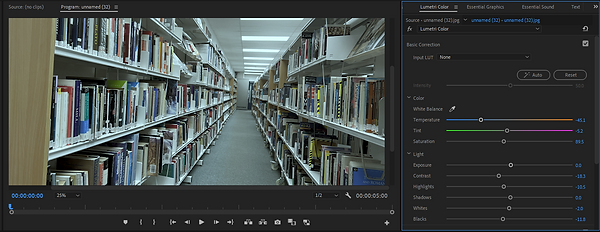
This one is quite similar to the first one but I think this one is just more blue like you can really see the hues of blue that I have added. And with the temperature I shifted the asset onto the more cooler blue tones and also adjusted the saturation a bit down but not so much so you can actually see the highlights of blue. So here I just used the colour wheel and tried out how light or dark I wanted the shade of blue to be. However I would not really use this because it is a bit too dull for my liking of the theme of my documentary and I just don't think it would align with what I am going to be including in my documentary.
Purple tone
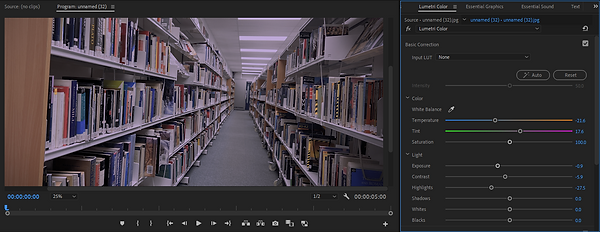
For this final one I was unsure of what colour to experiment so I tried purple and also for this one I decided to try out one of the presets on premiere pro. I liked the presets but I think it was too intense so I did some adjustments myself and adjusted aspects such as the highlights and tint. And also used the colour wheel to get the purple colour. Although this was a nice colour to experiment with and the final product wasn't actually too bad I don't really think it's appropriate for my documentary and I think it is better to use for like a short film or a music video instead.
Conclusion: Overall I do think that colour grading and correction was a useful technique for me to practice in terms of learning more editing techniques. I was just really able to experiment with colour correcting the image and also just working with different colours and adjusting things like the tint and highlights, was useful because I was able to be creative and test out different tones although some of them wouldn't be what I would use I still think it was a useful technique for me to learn because for future projects it would be useful to know these. Moreover, out of all the different colour grading I tried I think that the first one and the last one were my favourite. The first one I would say is one I will definitely be using in my documentary I like how there isn't any bright highlights that would take away from the subject if they were in frame and that the dark theme really goes with what my subject is about because it doesn't really start off positive so I think that the low exposure and very light hues of blue is just perfect, but possibly for the actual product I might turn the exposure up a bit more because it may seem too low. But I think that effect looks great and it would give my documentary like an old school aesthetic mode to it. I also did like the purple toned one I wouldn't use it for my documentary because I think it could be used more for like a short film or music video especially. But I really went in depth with editing that one and I liked the outcome it gave like a periwinkle tone which actually seemed quite nice to me. To conclude, I think the one I definitely consider using is the first image that I edited.
Blur background on Premiere Pro
Why I did this?
So I just wanted to try out different editing techniques on Premiere Pro so that I am expanding on my knowledge since my aim was to improve on practical aspects such as editing. I decided to try out the effect where the background gets blurred apart from the subject. I thought this would be interesting to test out because I can even use this when I am conducting those interviews and also discussions from expertise and stuff and try like blurring the background just for a more appealing effect. Hence I wanted to test out what it would look like and depending on that I can see whether to not to include it in my documentary.
So this was the video that I watched in order to help me edit. I just followed the tutorial and tried out the different features till I got the outcome I was expecting. The video was actually pretty straightforward and it was only about a minute long and it took me less then 4 minutes to actually perfect it. But I am glad with the final result and think I have followed the tutorial pretty well.
Original video

So this was the original video it was taken on my phone and there is nothing wrong with it there is a bit of an accidental shake in the beginning but overall I think it was filmed well and that Bea was the main subject in the frame hence the focus will be on her. Moreover, it just seemed like a normal interview/discussions that are included in a documentary.
Video after edit
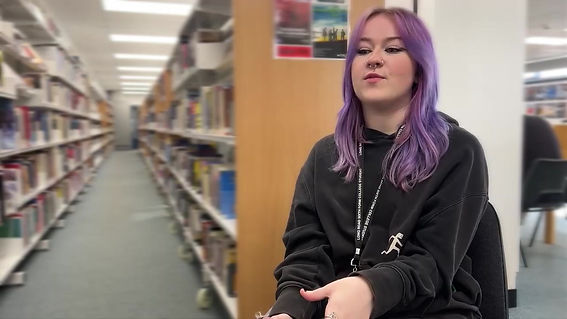
So basically for the result of this effect I had to drag the blur aspect onto my video as the first thing. Then I had to go over to the effects control and select the draw tool and drawing an outline of Bea so drawing it around her since she is the subject of that video. And then I click on the stop watch icon on the mask path. And then in some part since Bea was moving around I had to continue playing the video and adjusting the outline to how Bea moved so it is in place correctly throughout the video, this was quite tricky but it ended up giving a decent outcome. Then I just adjusted how blurry I wanted it and I liked it a bit more blurry so I made that number higher for how blurry I wanted it and I also just played around with the feather effect too so I can see what outcome I wanted. Moreover, this was my final product and I am actually surprised with how good it is so far just for my first try because I hadn't used this effect before.
Conclusion: I do think that this was an interesting effect to try out and I did really liked how it brings the subject as the focal point in the frame and makes them stand out by removing everything from the background. However I would not use it in my documentary. I think this because I feel like if I was adding my interviews and discussions with expertise I would want a more natural feel to them and I am unsure if it is the way I edited that or made it too blurry but I don't like the outcome too much. I would prefer a more natural feel to the interviews I will conduct, so including like the background but still making sure that the subject is what is the main thing in the frame. So overall although this was a nice effect to experiment with and is useful for me to learn because I can use it in future projects, I just don't think it would look appealing for my documentary and according to the way I want my documentary to look if I add this effect I think it just won't give it that natural feel so I have decided not to use it.
Testing sound
Why I am doing this?
So I decided to test sound because using sound equipment is really important for a good documentary outcome. Even from the different examples I have seen sound was used very well in them and I was able to hear everyone very clearly without any sort of background noises. So I wanted to test out different sounds and compare them so I decided that one sound I will record from my phone and the other will be used from a microphone from the sound kit, and then I can compare these two to see which ones are better and figure out what are the differences and similarities. And this will also just inform me of the positives that come with using sound equipment in a documentary and also help me conclude what I should be using and why.
So when I went to then test out the sound I did two sounds and then the other two included talking. I know that sound is essential when it comes to making a documentary, and especially within my documentary when I will be doing voiceovers and other people will be talking in interviews and like discussions I will use the sound kit hence I tried out just talking into he microphone then compared it with the recording on my phone. If I were to include foley sounds it will probably be depending on the clips I have filmed where I may think recording that sound would be better.
Sound one: Knocking
If comparing these two sounds I think the knocking on the phone sounded better. I feel like with the one recorded on the microphone is a bit more quieter but still clear but I preferred the one from my phone because I feel like it just sounds a bit more louder and obviously makes it sound a bit more clear and you couldn't hear any background noise on either of these so that was also a positive because a phone recording would likely catch more background noise I am surprised it didn't probably because there was no one else in the room. Besides that, I do think the one on my phone sounded better for testing this because it just sounded a bit more louder so it sounded like a proper knock.
Sound two: Closing a drawer
So for this foley sound, I decided to test out closing a drawer. Out of the two I think that the one recorded using the sound kit sounded better. It was just more louder here so you can really hear it better compared to the recording that was done on the phone. I also just think the microphone from the sound kit gave the sound like a crisp and good quality which made it sound better compared to the phone one. And with the sound that was recorded on the phone I think you can kind of tell it was because it had a more poor quality compared to the one recorded on the microphone.
Sound three: Data on mental health
So for the next sound testing I decided to talk into the microphone about data regarding mental health, because this is something I will be including in my documentary to prove my points. Comparing these two I came to a conclusion that the one recorded using the sound kit was my favourite one it just sounded so much more professional and actually worthy to add into my documentary compared to the one recorded on my phone. I think the recording from the phone was also able to pick up more background noise compared to the one recorded using the microphone from the sound kit. Overall, from these recordings I definitely think the one recorded on the microphone had better sound quality here.
Sound four: Interview question
So once again I decided to include a question about mindfulness. Although I won't be asking any direct questions like this in my documentary because I would rather it be like a discussion from the people I still decided to test it out just in case I do ask questions in my documentary to the people that will be involved in my interview. So once again I definitely think that the microphone from the sound kit had a better audio quality compared to the one recorded on my phone. I think the one recorded on my phone was a bit more quieter and also not so clear whereas if I compare it to the one recorded on the microphone it is so much clearer and sounds a lot better with no background noises. Moreover, for testing this sound out I think once again the sound kit microphone did it better compared to the recordings taken on my phone.
Evaluation: From testing sound equipment for my action research I was able to get a better idea of why using a professional sound kit is much better compared to if like I was going to use my phone. For my action research, I decided to test out sound equipment and compare it to what the recordings would sound like if I were to use my phone. And in order to prepare I booked the equipment out for the lesson. I first started to write about what I am going to be doing for my action research under it to give like a brief, then it was the time for my to go collect my equipment so I went and did that. I decided to also include my friend to help me in this because I needed someone's responses when I was going to ask like an interview question, and since I will be testing the interview questions out I obviously needed someone to answer them so he helped me out. We communicated first and decided who was going to do what, since I am recording the sound sand he did the answering questions and also the closing of the drawer, the rest I did myself. But everything worked well together and we had no issues. The skills I needed to demonstrate in this task was the ability to use the sound equipment and test out sounds and compare them from my phone as well. There wasn't any particular difficulties or issues I faced because I understood the instructions well and also I knew how to use the equipment which was good so it was pretty self explanatory. The only thing I spent a bit more of thinking is like when I was deciding what sounds I could make and compare, but since we did do a foley sound task previously it was actually useful because it helped me to remember what other sounds I could record. There wasn't any specific major skills I got from this practical but I was just glad I was independently able to complete this sound research independently and for future like when I conduct my interview using the sound equipment I will know what to do and how to use it. If I could change one thing there wouldn't really be anything because I think this was quite a successful action research, but maybe next time I could test more like useful sounds and practice more speaking into the microphone more confidently. I did manage to complete all aspects of this task. The thing I enjoyed the most about this task was being able to also involve my friend within the task it just made it more fun to complete the task. Furthermore to conclude, from testing out sound from my phone and through the microphone from the sound kit. I will definitely be using the sound kit when I have to do like the interviews and stuff because the quality just sounded ore professional and documentary like.
Editing transitions
This is an informative video that I watched about filming transitions and he even demonstrated how I can do them. I decided to pick two one which was the subject movement one and the other was just a sky transition. I decided to test out transitions because I wanted to add like one transition maybe when people are talking in the interviews and like position the camera differently, so I thought this would just help me edit and also understand the basics of doing transitions so I tested them out below and it was actually not too bad.
Subject movement

Sky transition

Evaluate: So when deciding this action research me and Bea decided we were going to test out transitions and I also realised that many of the examples I watched of documentaries so many of them had included transitions and I noticed that especially when they were occurring during the interviews/discussions that were coming from expertise and other persons. It had just shifted so smoothly from the camera angle being on one side to then shifting quickly onto the other side so maybe getting like their side profile then. So that is when I decided I wanted to test the transition shots. And for making these transition edits relevant to documentaries and actually be something I can include I decided to research on YouTube to find out different transitions that I could do so I found that video watched and picked two relevant transitions that I could try out. First of all, I decided to do the sky transition one because in the beginning of my documentary I want to include like a good quality scenery video either of the sky or like trees, but something beautiful. And I just wanted to test out a sky transition because possibly I could include this in the beginning as well. Furthermore, I also did the subject movement transition this was useful because this means I can try this transition out when conducting interviews and also when subjects are having a discussion so I can change the position of filming so it looks like different camera angles basically, and this will obviously look better when I edit it more smoothly to make it look more neater compared to this video. However, when editing this there wasn't much special effects that I had to use I just placed the clips beside each other and also just added the cross fade which just made everything seem a lot smoother and put together. Moreover, I think this was quite a fun yet helpful technique to test out because me and Bea filmed various clips and then when it came to editing I tried to match them up and see how they align and one of the other clips was just not working well together to create a nice transition hence I was only left with these two to use that were actually relevant to my project.