EPQ
Brief Plan For Documentary:
Beginning: two pages with black background, first which gives a disclaimer/trigger warning that suicide is going to be mentioned so graphic content will be mentioned to viewers. The second will be helplines young people can contact so will list phone numbers for people to access. (this will be on for about 5-7 seconds)
Introduction: Slow-mo. video of scenery so maybe shots of trees and close ups of leaves moving around from the wind. (music starts and then voiceover gets gradually included, here music is still playing over the voiceover but a bit more quietly.)
Then it shifts to a group of people walking this will be a close up mid shot and this will also be in slow motion, and the voiceover here will be used from archive material, so I decided to use a news article regarding mental health but I will only use what it says as a voiceover on top of the clip I film of the group of friends walking.
Now the title of the documentary will be introduced and the video in the background will be a slow motion video of scenery. And music will be added here too but this will be a bit quiet too.
Then a clip of a college counsellor saying an important message of how severe mental health is getting amongst young people will be added, this will be a short clip.
Then I will cut to archive material so for this I will show 2 parts of data regarding the increase in mental health issues as well at that I will do a voiceover explaining the data given.
Next, the college counsellor will introduce themselves and what they do and talk about if mental health is taken seriously in educational institutes. Then after she is done the screen will go black for about a second then music slowly starts to add in.
As the music is still going on I will take a static mid shot video of Bea just looking into the camera, and as this is happening the music will go quieter and as the video of Bea is still going on her voiceover will start like near the middle end where she says her name, where she studies and how a bit about her mental health journey.
now the camera will shift to Bea and this is going to be a mid shot this will be like an interview discussion, here I have interview questions prepared and I will ask these to her. Then at the end of this, since this interview is held in college I will do a long static shot of like a corridor like near where the interview was held.
Then there is going to be a voiceover of Bea speaking about some positive things that have influenced her mental health and for this the video in the background will be of her walking along and this is going to be a long shot. And when I edit this it will be in slow motion.
Depending on if I get permission, after that, like a mid shot inside like the NHS will be taken, and there is no music here and it will be a few seconds long. After that it will shift to either an interview from someone that works at the NHS that deals with wellbeing or a written statement from them. If it is an interview it will be a mid shot. They will just talk about ideas they give on ways to deal with bad mental health issues. (if unable to get something from the NHS I can interview peers and get their opinions or another college counsellor) Then it will just cut to a black screen for like a second once it is done.
After this, I will actually start talking about how mindful walks, being with my friends and exercising has helped my own mental health and this will be like advice for my viewers. So for this in the background the videos will be the things I say in the voiceover so if it was like spending time with my friends I will show clips on that so as I talk, the clips I filmed will be shown in the background. These are all going to be medium long shots and static.
Then it will cut to me doing a voiceover introducing mindfulness and how that plays an important part and as that voiceover is happening the video shown in the background will be a book which is about mindfulness that I have and I will show like a page of it as a close up whilst I explain the definition, then I will start mentioning a brief dos and don'ts of practicing it and as I am saying this in the voiceover the clip in the background will be archive material of a DBT group handout from the NHS which states the dos and don'ts.
The next discussion will be from Bea again this will be a medium shot of her sitting and here she will discuss mindfulness and how practicing it was recommended to her and if she thinks it's helpful. Then as she stops speaking the screen will turn to black.
Ending: After that I will conclude what was said the documentary, and end it off with like an important message regarding why you should be reaching out if you need help. And the background video of this will be two video so one of like a group of friends laughing and talking and the other just of scenery and they are both going to be slow mo. videos but these will be static shots.
Then finally, to end the documentary it will just fade to a black screen with the name of the documentary again and the music will be added gradually back again during this.
Risk assessment

So a risk assessment is obviously essential when filming, and since I am doing documentary there will be quite a few also depending on other factors such as location and what my documentary includes. But here when completing this document there wasn't many risks I could think of mainly because I won't be doing any activities that are like out of the box. And the parts that I have to film such as the interviews will be more indoors and in quieter areas. But the main risk I think could be an issue is weather depending on that the floors will be slippery to film outdoors, but regardless I will plan my filming days correctly and check the area I am filming in so nobody gets hurt or any disturbances. But these are still some hazards I thought could occur whilst filming anything in general that I have to film.
Interview questions

So these are some brief questions I will ask my friend in an interview. I didn't put more because I think that these are enough to get me answers in what I have to provide for my target audience. But for the first question I mentioned about professional help because this is a key part in my documentary and the target audience need to see evidence of it being useful. And the second question mainly focused on what advice they would give after their journey and experiencing many things. I tried to make the questions not seem just like a yes or no question because those aren't recommended whilst interviewing people for a documentary. However, the last one I kept it short and made it a yes or no question but if the person wishes it would be advised to add onto her answer to explain why she thinks that. But the other top two are their personal opinions and therefore they will have to explain why this will be informative for the audience to know since it is an opinion coming from someone that is within my target audience too. This means that it will help my target audience in understanding a bit more better because they are hearing someone's opinion that is also just like them.
Script


This is a short script I wrote up, these are all the times I will be doing voiceovers so from the beginning till the end, and also when I include archive material and data I will speak over it and talk about what is going on. This is quite a short script because a majority of the documentary is going to be mainly focused on opinions and advice from expertise and peers.
Script done on studio binder:
Shot list

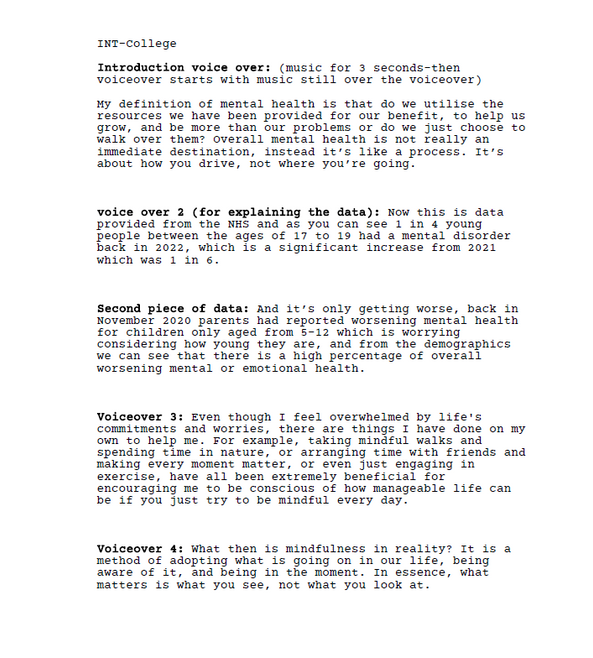

Here is the list of shots that I am going to be including and what their meant for. But here I added the introduction where I introduce my documentary with a nice visual with some music in the background and the subject, a lot of them are interviews of people. And also clips of people and scenery because it is related to what I will be talking about in my voiceover. And where in certain clips what I say in the voiceover I will make sure I also show it because it should be then more engaging for the audience.
Location recce


This is the location recce, where I showed the places that I am going to be filming. But this is not certain because it also depends if that classroom is available and I also might find that a different part of college has better lighting to film but most likely these places are definite but if surrounding areas are better they may be used. And also here I talked about lighting since I will be using natural lighting so I will need to figure out how I am going to get good natural lighting and this will have to be through like filming near a window so for an example filming the interviews near a window to get in natural light.
Archive material I will use:


So these two pieces or archival material is data about mental health. I chose these two because it provides like evidence for how severe it is amongst young people especially. And especially with the data on the right hand side which literally states children between the ages 5 to 12 which is shocking. And these pieces of data should be used to raise more awareness from my documentary so my target audience realises that it is serious and action should be taken in order to reduce the severity of it and actually help young individuals out.

So for this archive material which is the video, I will not actually be using the video. But instead, when editing I will unlink the video and audio and keep the audio but get rid of the video, because I want what the news reporter saying to go over some clips that I will film. This also once again shows how serious the issue is getting within young people.
This is the only song that I will be using throughout my documentary so for like the introduction and the ending. I chose this song because it is tense and upbeat at the same time. I first heard this other music but although it sounded quite cinematic I felt like it was too emotional and I think that would only be appropriate for the beginning because that is when the documentary will state the bad effects of mental health and the severity. But I didn't want to choose like different songs I just wanted one song that would suit each clip where I actually wanted to add music. And this was the song that was a bit of both so inspiring and emotional hence I decided I was going to use this song.
Editing audio

This piece of archive material is a DBT group handout sheet provided by the NHS, it has many sections regarding mental health. But since I will particularly also be mentioning mindfulness I decided to choose that certain section and then when I am doing a voiceover over it I will explain what each of those points mean and their significance.
Disclaimer and phone numbers I will include for viewers (in introduction):
The following documentary includes stories of mental health disorders and suicide.
If you or someone you know have any thoughts of such call the National Suicide Prevention Helpline UK on 0800 689 5652 or you can contact Samaritans on 116123 and it is 24 hours a day, 365 days a year.

When editing audio such as the voiceovers I made sure to use Adobe Audition. And whilst I used it I made sure to make the voiceovers a bit louder because they were quite quiet so I made it louder and using the properties tool I also added features such as DeNoise and noise reduction and just played around with the different effects until I have a good outcome I liked.
Testing out whether the audio fits well with the clips I have filmed and it does sound actually quite good quality wise, regarding for recording sound on my phone in this clip because I wanted this footage to seem quite like a natural and raw interview for an example like the ones on vogue where the camera like follows the person around, but it worked out pretty well.

Example of an audio I have edited for the documentary:
not edited
edited
The difference is pretty self explanatory to tell because if we compare both audios we can also tell that the first audio is a lot more quieter and had a bit of background noise to it but after it was edited it elevated the audio entirely and is able to hear much more better.
Slow motion video on Premiere Pro:
This is a quick video I watched to test out on how to do slow motion on videos in Premiere Pro correctly and then adjust it to my liking it was relatively simple to follow.
Here is the clip I edited to make it in slow motion since this is a clip I will be editing for a slow motion effect and it was okay like I understood the basics but I still think I need to do some more research on how to make it smoother and look more natural and subtle.

Editing
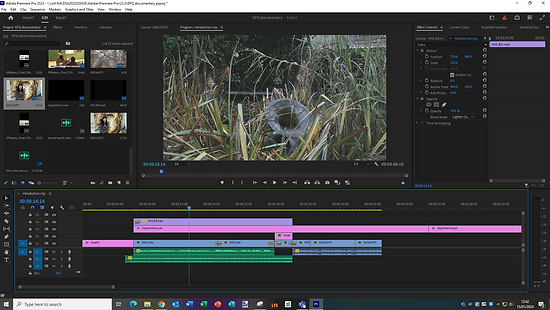
So whilst I was editing here I discovered how to add the editing throughout my documentary and also besides that I went onto Google and found a VHS download website which then I could also include in certain parts of my documentary where I think it looked good.
When I used colour correct and also through help of the colour wheel I was able to get a similar tone to what I decided I wanted in my action research as the colour theme throughout my documentary. I used this because it enhances the camera quality as well and I wanted to give this documentary like a old school/aesthetic idea and make good use of the handy cam and enhance the quality and turn it out into something appealing that I would like.


This is the VHS effect that I downloaded onto my computer so I can add bits of it I certain spots in my documentary where I think it looks good such as the introduction.
Documentary rough edit

Reflection: When I was doing my production I found that it was a lot easier then I thought so. So according to my plan everything fell into place how I expected it would go. So when I started filming I managed to get the main bits which I had to film first because it aligned with my friend's availability as well since she was going to be included in the documentary so I managed to get that done first. Furthermore, as I was filming I was also quite innovative because there was some random clips I had to film and try explore which ones would fit for like the introduction of my documentary. I was glad I was able to take random clips because the more I would take the better it would be for me because this means that I would be able to pick and choose from the variety and see which clips I liked and will use. With a effective pre production all the other aspects I would include when I am filming were already decided so I just had to add that in such as how I was going to colour grade the documentary and also the music that I will be using in my documentary. As I was filming I also managed to get the parts that I had to record myself done such as the voiceovers that I had to do so I can get that done with. And also because all the interviews and clips I had to film myself could get done later. As I was filming the interview I had no major problems surprisingly apart from that in one of them the lighting was quite dark because the room was quite indoors as there wasn't a proper window near by so the natural lighting wasn't able to get in properly so instead I relied on the colour grading of that clip. Also I found that adjusting the handy cam onto the tripod was quite a challenge because it just wouldn't stay still but I had to just use my hand also to hold it steady so that the clip is in frame and isn't wonky. Besides that managing the filming and the sound equipment wasn't as difficult as compared to before I took my time and managed everything step by step and I had enough time so I could even re film if I needed to. Despite that the interviews that I had to film went perfectly fine. But one interview I had with a teacher did not get as well because then when I went to look for the clips they turned out to not get uploaded to my computer therefore I told the teacher and requested if I could meet up with her again and if we could re film those clips, she did say she would re book with me but she hasn't emailed me back so I am just using what I have right now, and I do think that I have enough interviews because I aimed that I will get 2-3 done and I do have about 3 so that should be enough so I can meet up with my time frame because I also have other things that I will need to include. Moreover to conclude, I think that for the rough edit I have produced a good amount in the time I had and also worked quite hard in order to get it to look like that and film everything and record stuff independently that I had to. I thought it would be a lot more difficult but I am pleased that I managed to get stuff done pretty well but for next time I want to just be a bit more organised with knowing which random clips that I will film and also use more appealing locations but for this one I investigated mental health like within educational institutes and like students hence a lot of the stuff was filmed at college. Furthermore, I think the rough edit is looking alright so far and I still have a lot more to add so I will be working on that in the mean time.